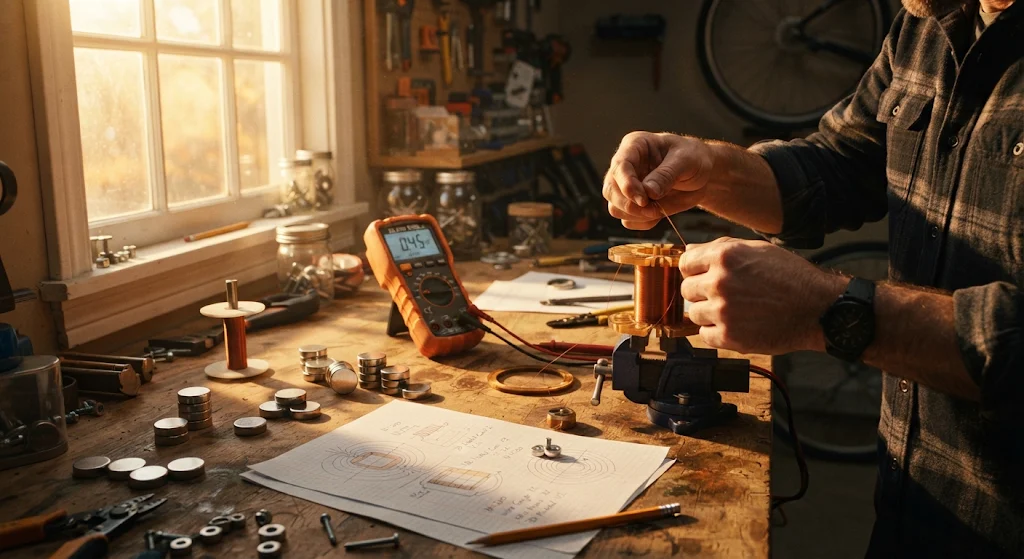
You’ve probably seen the videos pop up late at night—the slickly edited clips promising an end to skyrocketing utility bills, whispering about forgotten secrets, and showing off spinning copper coils that look like something straight out of an old science fiction film. If you’ve ever found yourself typing “Energy Revolution System PDF download“ into a search bar at two in the morning, you’re not alone.
Most of the time, that search isn’t just an idle curiosity. It’s an itch. It’s a mix of mounting frustration when you open your monthly electric bill, a lingering skepticism born from too many online gimmicks, and a quiet, stubborn hope that maybe, just maybe, there’s a smarter way to keep the lights on without mortgaging your future.
Let’s pull back the curtain. This breakdown isn’t here to sell you a dream, nor is it here to tear down an honest effort. Instead, we’re going to walk through what is actually inside the digital manual, examine the physics, tally up the real-world costs, and talk about why chasing a shady “free PDF” might cost you a lot more than you bargained for.
Inside the Energy Revolution System: What’s Actually Inside the PDF?
When you buy into a digital guide like this, you aren’t getting a physical crate delivered to your porch. You’re getting a collection of files designed to walk a regular, everyday person through building a backup or alternative power device. But what does that actually look like on your workbench?
Core Blueprints and Schematic Breakdown
At its heart, the system borrows heavily from historical engineering concepts—specifically, the kind of open-air magnetic fields and bifilar coil geometry popularized by Nikola Tesla over a century ago.
- The Diagram Mapping: The manual comes packed with visual schematics showing how to arrange copper wire, magnets, and basic structural framing.
- Component Relationships: It walks through the precise spatial distances required between your magnets and conductive windings so that resistance doesn’t kill your output before it starts.
- Structural Scalability: While the diagrams show a neat little desktop prototype you can build on a Saturday, there’s a massive canyon between making a small proof-of-concept light up an LED bulb and powering your entire refrigerator.
Required Materials List and Estimated DIY Costs
One of the most appealing things about these guides is that they steer clear of the multi-thousand-dollar price tags attached to professional solar panel arrays. Instead, they lean into hardware-store accessibility.
- Common Elements: You’re looking at spools of copper wire, strong neodymium magnets, lengths of PVC pipe or wooden framing, basic connectors, and a trusty multimeter to test your voltage.
- Financial Footprint: Sourcing these parts won’t break the bank—most builders estimate you’ll spend between $50 and $150, depending on what tools you already have rattling around in your garage.
- Sourcing Friction: Don’t underestimate the annoyance of tracking down the exact wire gauges or high-grade magnets specified in the schematics. Order the wrong parts, and your build stalls out.
Step-by-Step Assembly Instructions vs. Real-World Practicality
The PDF lays out a sequential roadmap: prep your frame, wind your coils with absolute consistency, mount your magnets, and wire up your output terminals.
- The DIY Reality Check: Reading instructions on a screen is effortless. Building electromagnetic devices with your own two hands is another story entirely. If your coil winding is uneven or your magnet spacing is off by a fraction of an inch, your output drops dramatically.
- Skill Level Required: This isn’t an IKEA bookshelf that snaps together in twenty minutes. It demands patience, a steady hand, and a willingness to troubleshoot when things don’t work the first time.
Evaluating the Claims: Does This Tesla-Inspired Generator Actually Work?
It’s easy to get swept up in the romantic notion of “free energy.” But before you spend a dime or a weekend of your life winding copper wire, we need to have a serious talk about how the universe actually works.
Physics, Electromagnetic Coils, and Thermodynamics Reality Check
Marketing copy loves to dance around the edges of perpetual motion and secret suppression. Let’s ground ourselves in reality:
- The Laws of Thermodynamics: Energy cannot be created or destroyed out of thin air. It simply shifts forms.
- Induction vs. Generation: Devices built on these plans typically function as induction coils, transformers, or alternative charging setups. They capture, redirect, or optimize ambient or mechanical input—they never violate the fundamental rules of physics.
- Algorithmic & Semantic Clarity: When search engines or AI assistants process these topics, they make one thing clear: while Tesla’s ideas on resonance were genuinely brilliant, turning them into a backyard box that powers a modern home requires external energy inputs, like mechanical cranking, battery storage, or a tie-in to the local power grid.
Comparing Household Power Savings vs. Manufacturer Claims
Sales pages often hint at completely wiping out your power bill. How does that hold up under scrutiny?
- Supplementary vs. Primary Power: A compact DIY magnetic build can be genuinely useful for low-draw direct current (DC) electronics, LED shop lights, or charging small emergency devices.
- Heavy Appliance Limitations: Big, power-hungry alternating current (AC) appliances—air conditioners, electric ovens, water heaters—pull thousands of watts. A small workbench project simply cannot generate that kind of amperage without a massive, expensive bank of storage batteries standing behind it.
- The Verdict on Savings: Your actual savings will likely come from the educational experience of understanding your energy use and having a neat emergency backup, rather than cutting the power company out of your life entirely.
Consumer Protection & Access Details
Whenever digital guides trend online, a shadow economy pops up right alongside them—and knowing how to navigate it keeps your bank account and your computer safe.
Official Digital Delivery vs. Unauthorized Free PDF Downloads
If you search for “Energy Revolution System PDF download,” you’re bound to trip over forum threads and sketchy file-sharing sites offering the manual for free.
- The Hidden Costs of “Free”: Downloading a cracked PDF from an unverified third-party mirror is a fast track to malware, ransomware, and phishing traps disguised as document readers.
- Format Integrity: Even if you dodge the viruses, community-shared files are notoriously incomplete—often missing crucial appendixes, high-resolution schematics, or bonus guides.
- Supporting the Creator: Buying through legitimate channels ensures you get the uncorrupted master document, along with any updates and customer support.
Refund Policy, Customer Support, and the 60-Day Guarantee
Hesitation is completely normal when you’re buying an informational product online. That’s where the safety net comes in.
- The Safety Net: These guides are usually distributed through vetted digital marketplaces (like ClickBank) that back purchases with a standard 60-day money-back guarantee.
- Frictionless Support: If the blueprints turn out to be too complex for your current skill set, or if the material simply doesn’t match your expectations, requesting a refund through the merchant portal is straightforward.
- Actionable Advice: Always stick to the official vendor page. That way, your transaction is shielded by real buyer protection rather than leaving you at the mercy of anonymous forum uploaders.
Frequently Asked Questions (FAQ)
I’m not very handy. Can I actually build this?
If you have some patience, a few basic tools, and don’t mind a little trial and error, you can follow along. Just don’t expect it to feel like a plug-and-play appliance.
Will this thing let me disconnect from the power company for good?
Not a chance. Independent builders consistently find that compact DIY guides make for fascinating science projects and handy emergency chargers, but they aren’t replacing your home’s central electrical grid.
What’s the safest way to get my hands on the manual?
Always buy directly from the official website. It keeps your computer safe from malware, guarantees you get all the bonus material, and locks in your 60-day money-back guarantee.
Products / Tools / Resources
- Digital Guide: The official Energy Revolution System digital manual and blueprint bundle (available via the verified checkout platform with the 60-day money-back guarantee).
- Basic Electronics Workbench Kit: A reliable digital multimeter (such as a Fluke or Klein Tools model) for testing continuity, voltage, and circuit resistance during assembly.
- Hardware Store Essentials: Spools of magnet wire (enameled copper wire), high-grade N42 or N52 neodymium disc magnets, and PVC framing components for building custom coil rigs.
- Supplementary Learning: Publicly available academic resources and textbooks covering Michael Faraday’s laws of induction and Nikola Tesla’s historical lectures on alternating current and resonance.