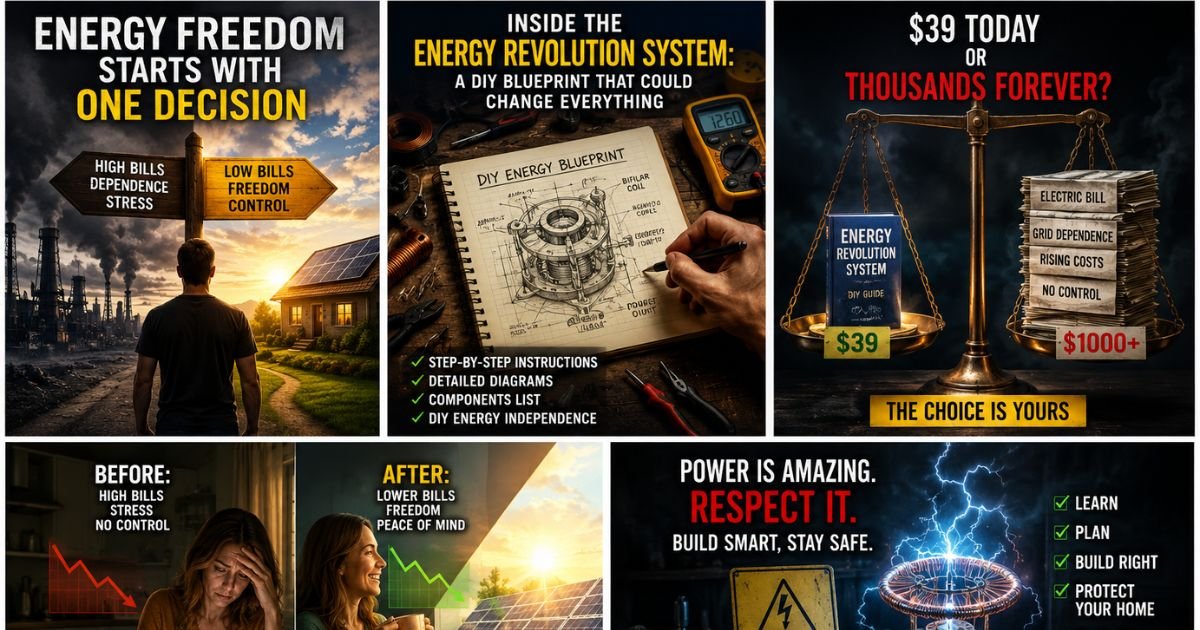
This Energy Revolution System review takes a closer look at what the $39 digital guide actually offers, how it works, its biggest claims, potential risks, refund policy, and whether it’s worth buying in 2026. There’s a particular kind of promise that makes people stop scrolling.
Cut your electricity bill dramatically. Build something yourself. Spend around $39 instead of thousands. Take back a little control from an energy system that seems to get more expensive every year.
That’s the appeal behind the Energy Revolution System.
But there’s a problem with attractive promises: sometimes the most important part is what they leave unsaid.
If you’re considering buying this program, you probably don’t want another breathless sales pitch. You want to know what you’re actually getting, how the system is supposed to work, what the impressive savings claims really mean, what it could cost beyond the initial purchase, and whether the whole thing makes sense for an ordinary homeowner.
That’s what this Energy Revolution System review is about.
And right from the beginning, there’s one distinction worth making: Energy Revolution System is a digital DIY energy guide—not a finished generator, supplement, medication, or professionally installed power system.
That single detail changes the way the entire offer should be evaluated.
Current product pages advertise the guide at around $39, with some versions showing a higher reference price and a 60-day money-back guarantee. The material is delivered digitally rather than arriving as a physical machine at your door.
So the real question isn’t simply, “Is $39 a good deal?”
It’s this:
Does the information inside justify the expectations created by the marketing?
That’s a much harder question—and a much more useful one.
What Is Energy Revolution System and How Does It Work?
Imagine opening a box expecting a generator and finding a set of instructions instead.
That’s essentially the position you’re in with Energy Revolution System.
The product is marketed as a DIY home-energy blueprint designed to show buyers how to assemble a small supplemental-energy setup using electrical components and materials that can be sourced separately. The package is described as including blueprints, diagrams, step-by-step instructions, and information about the required parts.
In other words, you aren’t buying electricity.
You’re buying instructions for attempting to build a system that is intended to produce or supplement electrical power.
The concept draws heavily on electromagnetic principles, including the bifilar pancake coil associated with Nikola Tesla. A bifilar coil isn’t imaginary technology. It is a legitimate coil configuration involving two adjacent windings, and the arrangement changes the electrical characteristics of the coil.
That part deserves to be separated from the bigger marketing story.
Electrical engineering is real.
Tesla’s work is real.
Electromagnetic induction is real.
None of those facts, by themselves, prove that a particular homemade device can deliver the extraordinary savings sometimes suggested in promotional material.
And that’s where skepticism becomes useful rather than cynical.
Some Energy Revolution System sales pages have promoted potential electricity savings of up to 80%. That’s a powerful number. It immediately creates a picture in the reader’s mind: an electric meter slowing down, monthly bills shrinking, perhaps even a sense that the grid has suddenly become optional.
But an advertised maximum isn’t the same thing as a guaranteed household result.
Your home isn’t an abstract circuit diagram. It has refrigerators that cycle on and off, air conditioners that draw substantial loads, lights, computers, pumps, fans, televisions, chargers, and dozens of other electrical demands. The actual performance of any supplemental-energy system depends on what it produces, what you connect to it, how efficiently it operates, and how safely it is integrated.
There is another detail people sometimes overlook.
Energy Revolution System is not presented as a professionally installed whole-home power system.
It’s a DIY project.
That means the person holding the instructions matters enormously.
A blueprint can tell you where something goes. It cannot magically give you years of electrical experience. It cannot inspect a connection. It cannot notice that a component is overheating. And it certainly cannot replace local electrical codes or professional judgment where those are required.
The official material itself directs users toward appropriate safety precautions and professional help where necessary.
That’s sensible advice—and it should be taken seriously.
The simplest way to think about Energy Revolution System is therefore this:
It is an educational DIY energy project with a strong energy-independence angle, not a guaranteed replacement for your home’s electrical supply.
Once you look at it through that lens, the product becomes much easier to evaluate.
Key Features & Ingredients Breakdown
The word “ingredients” can be misleading here.
Energy Revolution System isn’t a pill, powder, or nutritional formula. There is no active ingredient, daily dosage, or pharmaceutical mechanism hiding inside the program.
And there certainly isn’t a clinical trial in the conventional medical sense.
What you are purchasing is information.
That information is designed to help a buyer understand and construct the proposed electrical setup, with the product pages describing elements such as blueprints, diagrams, instructions, and a materials or parts list.
The package is therefore better judged as a DIY educational system than as a conventional consumer appliance.
So what do you actually receive?
The advertised package can include:
- Digital blueprints
- Step-by-step construction instructions
- Wiring and setup diagrams
- Parts and materials information
- Guidance for assembling the proposed system
- Digital educational material
- Additional bonuses depending on the current offer
That sounds straightforward.
But here’s where the glossy simplicity of the sales page meets the messier reality of a garage workbench.
A DIY electrical project isn’t simply a matter of following arrows on a diagram.
The quality of the wire matters.
The components matter.
The connections matter.
Insulation matters.
Grounding matters.
Load requirements matter.
And the person putting everything together matters most of all.
A design that appears inexpensive on paper can become more expensive once you start buying tools, replacement components, safety equipment, wiring, meters, connectors, and other materials. The advertised $39 price is the price of the information—not necessarily the final cost of building a functioning project.
That’s an important distinction for anyone calculating potential savings.
What about the clinical-trial claim?
There isn’t a meaningful clinical-trial framework for this product because it isn’t a medical treatment.
The more relevant question is whether the advertised performance has been independently demonstrated.
Here, the evidence becomes much thinner.
Some pages repeat large savings figures, and testimonials may describe positive experiences. But testimonials are not controlled engineering tests. One homeowner’s experience doesn’t tell you what will happen in a different house with a different electrical load, different components, different construction quality, and different environmental conditions.
That’s a crucial E-E-A-T distinction.
A testimonial is evidence of an experience. It isn’t proof of universal performance.
And what about safety?
There are no conventional “side effects” because you’re not consuming anything.
That doesn’t mean the project is harmless.
Electricity is wonderfully useful right up until a poorly insulated wire, incorrect connection, overloaded component, inadequate grounding arrangement, or unsuitable installation turns a learning project into a serious hazard.
Electrical shock, overheating, fire, short circuits, and damage to connected equipment are real possibilities when electrical projects are built incorrectly.
So if you decide to experiment, treat safety as part of the project—not as a footnote beneath it.
The absence of pharmacological side effects does not mean the absence of physical risk.
Pros and Cons: The Real Truth
The easiest way to review Energy Revolution System honestly is to resist both extremes.
You don’t need to call it a miracle.
You don’t need to call it a scam.
The interesting question sits somewhere in between.
The advantages
Low entry price.
The advertised purchase price is around $39, making the guide inexpensive compared with professionally designed energy systems.
Immediate digital access.
You’re not waiting for a heavy generator or hardware package to arrive. The core product is delivered digitally.
DIY accessibility.
The material is positioned around step-by-step guidance and diagrams, which may appeal to people who enjoy building things rather than buying finished equipment.
Educational potential.
This may actually be one of the strongest reasons to consider the product. Someone fascinated by coils, electromagnetism, electronics, and alternative-energy concepts could find the project interesting even if the promised savings don’t materialize.
Money-back protection.
The sales pages advertise a 60-day money-back guarantee, which reduces some of the financial risk of trying the digital material.
The limitations
Here’s where expectations need to be kept on a short leash.
The 80% savings figure isn’t independently established.
It’s an advertised claim, not a result that should automatically be expected in your home.
You’re buying a blueprint, not a finished generator.
That means construction, component selection, troubleshooting, and safety become part of your responsibility.
The real project cost can exceed the purchase price.
Tools and components aren’t necessarily included in the advertised $39.
Results can vary dramatically.
A DIY electrical system isn’t operating in a laboratory vacuum. The household load, build quality, component tolerances, and installation all matter.
Energy independence can be overstated.
A small supplemental-energy project should not automatically be interpreted as a replacement for a certified whole-home renewable-energy system.
And that last point may be the most important one of all.
If you’re expecting a tiny device to make your entire electrical bill disappear, you’re buying a dream.
If you’re looking for an inexpensive technical project that might teach you something about alternative energy, you’re evaluating a very different product.
Where to Buy Energy Revolution System at Best Price?
If you decide that the project is worth exploring, the safest starting point is the official website, rather than an unknown reseller or a site offering suspiciously cheap downloads.
Official Energy Revolution System website:
The currently indexed offer advertises the digital guide at approximately $39 and describes instant access along with a 60-day money-back guarantee.
Before clicking the payment button, though, take a breath.
Check the actual checkout price.
Read the current refund policy.
Look at precisely what the current package includes.
And make sure you understand whether any bonuses, upgrades, or additional offers are optional.
Why the caution?
Because online offers can change. Different pages associated with the product may display different reference prices or promotional language. The price you ultimately pay at checkout is more important than a crossed-out number on a landing page.
There’s also no conventional shipping timeline for the core product.
You’re purchasing a digital guide, so access is generally provided online rather than through physical delivery.
That’s good news if you’re impatient.
You don’t have to wait for a box.
But it also reinforces what you’re actually buying: information, not hardware.
Frequently Asked Questions (FAQs)
“Wait—am I actually buying a generator?”
No.
This is probably the most important question to answer before anything else.
Energy Revolution System is marketed as a digital DIY blueprint and instructional program. You’re getting information intended to explain how to build the proposed system yourself.
There isn’t a finished generator arriving at your house.
If you want something you can take out of the box, plug in, and use immediately, this isn’t that product.
“Can it really cut my electricity bill by 80%?”
That’s the claim that deserves the most skepticism.
Official marketing has promoted savings of up to 80%, but that number shouldn’t be interpreted as a promise that your household bill will fall by 80%.
There is no credible independent evidence establishing that outcome as a reliable result across ordinary homes.
Your actual electricity consumption matters.
So does the system’s output.
So does how the system is constructed.
And so does what you’re asking it to power.
Think of the 80% number as a promotional upper-end claim, not a personal financial forecast.
“What are the ingredients?”
There aren’t any in the supplement sense.
Energy Revolution System is an electrical DIY project. Its materials may involve items such as wire, copper, coils, electrical components, and other hardware described in the construction instructions.
The exact parts list should be checked against the guide you’re purchasing rather than assumed from a sales page.
“How much am I supposed to take?”
Nothing.
There is no dosage because this isn’t medicine or a supplement.
If you see language such as “dosage” attached to Energy Revolution System, you’re probably looking at generic review terminology that doesn’t belong to this product category.
“Are there side effects?”
Not in the pharmaceutical sense.
But don’t make the mistake of translating “no side effects” into “no danger.”
Electrical construction carries its own risks. Incorrect wiring, insufficient insulation, unsuitable components, overloading, poor grounding, or improper connection to household circuits can create dangerous conditions.
If you’re inexperienced with electrical work, professional assistance is the safer route.
“Has Energy Revolution System been clinically tested?”
Not in the way a medical product would be clinically tested.
More importantly, I found no credible independent engineering evidence demonstrating that the system consistently produces the advertised household electricity savings.
That’s the evidence gap buyers should keep in mind.
The technology may involve legitimate electrical concepts. That doesn’t automatically validate every performance claim made around the product.
“How long will shipping take?”
For the core digital product, there usually isn’t physical shipping.
The sales pages describe digital access after purchase.
If you buy physical components separately, that’s a different matter. Delivery will depend on the supplier you use and where you’re located.
So don’t wait beside the front door for a generator.
The thing you’re buying from the official offer is a digital guide.
“Is it actually beginner-friendly?”
The marketing certainly positions it that way.
The instructions are described as step-by-step, with diagrams intended to make the construction process easier to follow.
But there’s a subtle distinction worth keeping:
Beginner-friendly instructions are not the same as beginner-proof electrical work.
You can be perfectly capable of reading a diagram and still lack the experience required to recognize an unsafe connection.
If you’ve never worked with electrical systems before, take the safety side seriously.
“So… is Energy Revolution System a scam?”
I wouldn’t make that accusation based on the evidence available.
There is an identifiable digital product being sold. The advertised offer contains actual instructional material, blueprints, and related information.
The stronger criticism is about expectations.
The marketing can make the potential outcome sound much more dramatic than the independent evidence allows us to verify.
That’s different from saying there is no product.
A more reasonable conclusion is:
The product exists, but its biggest performance claims deserve skepticism.
That distinction matters.
“Could it replace solar panels?”
You shouldn’t assume that.
A professionally designed solar installation is an entirely different category of system. It can include rated panels, inverters, batteries, protection equipment, documented capacity, warranties, installation standards, and professional engineering.
A DIY blueprint isn’t automatically comparable to that infrastructure.
If your goal is reliable whole-home backup or long-term energy production, compare certified systems on measurable specifications rather than marketing promises.
“Is there a refund if I change my mind?”
The current official sales pages advertise a 60-day money-back guarantee.
Still, read the terms at checkout.
Online guarantees can have conditions, and processing fees or other exclusions may apply depending on the current offer.
Save your order confirmation and any relevant purchase information.
That’s a small habit that can save a surprisingly large headache later.
Final Verdict: Is It Worth Your Money?
Final score: 4.0/5 for the right buyer—not 4.8/5 as an unconditional recommendation.
That’s deliberately conservative.
For someone who likes taking apart gadgets, winding coils, learning how electrical systems behave, and experimenting with DIY energy concepts, Energy Revolution System could be an inexpensive way to explore the subject.
For someone staring at a rising electricity bill and hoping a $39 purchase will reliably eliminate most of it, the story is different.
I wouldn’t buy it on that promise.
The strongest parts of the offer are its low price, digital accessibility, educational angle, and advertised refund protection. The weakest part is the distance between the most ambitious savings claims and the level of independent evidence available to verify them.
So, is it worth your money?
For a curious DIY learner: potentially.
For someone seeking guaranteed 80% household savings: no—not based on the evidence currently available.
The smartest buyer isn’t the person who believes every claim.
It’s also not the person who dismisses every unfamiliar technology.
It’s the person who knows exactly what they’re paying for.
Products / Tools / Resources
If Energy Revolution System has caught your attention, don’t stop with one $39 guide. The broader energy question is far more interesting.
DIY Home Energy Systems
A useful starting point for understanding the difference between supplemental generation, battery storage, grid-connected systems, and true off-grid setups.
Recommended resource: research the fundamentals of residential power generation before purchasing components.
Tesla Bifilar Pancake Coil Resources
If the electromagnetic side is what drew you in, study the actual principles behind bifilar windings rather than relying exclusively on promotional explanations.
Look for reputable electrical-engineering references, university material, and technical demonstrations that show measurable input and output.
Solar vs. DIY Generator
This is one of the most useful comparisons to make before spending serious money.
Compare:
- Initial equipment cost
- Installation expense
- Electrical output
- Battery capacity
- Maintenance
- Safety
- Warranty
- Expected lifespan
- Measured efficiency
- Whole-home compatibility
A cheap experiment and a reliable energy system are not necessarily competing products. They can serve completely different purposes.
Home Backup Power Guide
If your real concern is keeping the lights on during outages, investigate dedicated backup solutions separately.
Look at:
- Portable power stations
- Battery storage
- Solar-plus-storage systems
- Standby generators
- Essential-load panels
- Transfer equipment
The right solution depends on what you actually need to keep running.
Electricity-Bill Reduction Resources
And don’t overlook the least glamorous option.
Sometimes the fastest route to a lower power bill isn’t producing more electricity.
It’s using less of it.
Energy-efficient appliances, insulation, efficient lighting, HVAC optimization, smart thermostats, sealing air leaks, and monitoring household consumption can produce measurable savings without requiring you to build an electrical device in the garage.
Electrical DIY Safety Resources
Before attempting any project involving mains electricity, grounding, high current, batteries, or household circuits, consult authoritative electrical-safety guidance and local code requirements.
A successful DIY energy project isn’t one that merely produces electricity.
It’s one that produces electricity without turning your home into the most expensive experiment you’ve ever conducted.