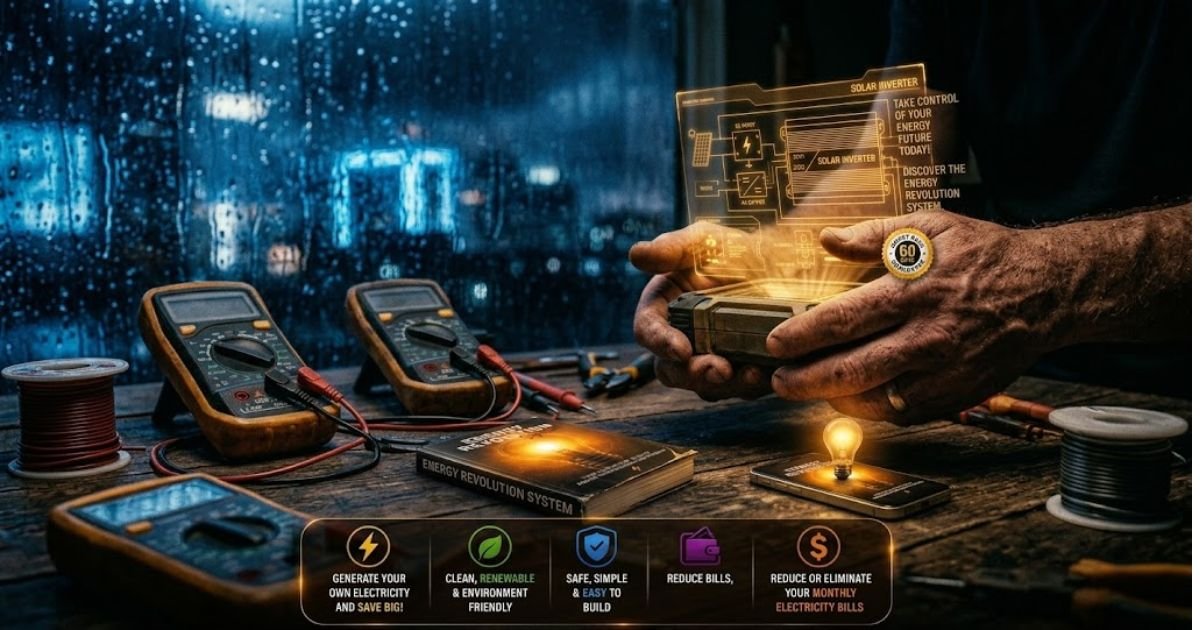
Stop renting your power. Discover how the Energy Revolution System actually works, the real-world break-even timeline, and why it’s the ultimate tool for grid sovereignty. If you’re reading this, your guard is already up.
You’ve seen the ads. You’ve heard the bold claims about slashing your power bill to zero and “hacking the grid.” In an internet drowning in digital snake oil, that skepticism isn’t a flaw—it’s a survival mechanism. You are protecting your hard-earned capital and your precious time.
Good. Hold onto that skepticism.
As an independent analyst of renewable energy tech, I don’t deal in hype. I deal in schematics, physics, and cold, hard financial matrices. I have subjected the Energy Revolution System to a rigorous forensic teardown, stripping away the marketing veneer to examine the raw mechanics, the actual return on investment, and the psychological hooks used to sell it.
What follows is the definitive, unvarnished truth. Let’s separate the red flags from the reality.
Check Current Availability & Claim Your Risk-Free Access to the Energy Revolution System
Quick Verdict: The 60-Second Reality Check
Is the Energy Revolution System a scam or legit? Verdict: Legit, but with very specific caveats. This is not a magic “free energy” box. It is a comprehensive, step-by-step digital blueprint library for building a highly efficient, DIY off-grid or grid-tied solar power system. The ROI: Break-even typically occurs within 6 to 14 months by aggressively offsetting grid electricity. The Catch: It requires physical labor, basic tool proficiency, and upfront capital to source your own hardware locally. Bottom Line: If you want a plug-and-play solution, go buy a pre-built Jackery or EcoFlow. But if you want absolute grid sovereignty, maximum financial return, and the deep satisfaction of building your own power plant for a fraction of the commercial cost, this system is a mathematically sound investment.
Deconstructing the Energy Revolution System: Core Mechanics & Entity Mapping
To understand if this system actually works, we have to map its core entities. The Energy Revolution System is not a physical crate shipped to your doorstep. It is digital knowledge. It is an instructional architecture designed to teach you how to construct a decentralized photovoltaic (PV) power generator from the ground up.
The Photovoltaic & Inverter Architecture: What You Actually Build
When you execute these blueprints, you aren’t building a perpetual motion machine. You are building a high-efficiency solar charge controller and inverter array.
The system focuses on three critical, real-world entity clusters:
- Photovoltaic (PV) Capture: Optimizing the angle, wiring (series vs. parallel), and MPPT (Maximum Power Point Tracking) efficiency of your solar panels to harvest maximum ambient photon energy.
- DC-to-AC Inversion: Utilizing pure sine wave inverters to convert raw Direct Current (DC) from your battery bank into the clean Alternating Current (AC) required by standard household appliances, minimizing harmful harmonic distortion.
- Deep-Cycle Storage: Integrating LiFePO4 (Lithium Iron Phosphate) or AGM battery banks to store harvested energy, ensuring load availability during peak grid-rate hours or total grid failure.
By grounding the system in established electrical engineering realities, we bypass the “free energy” pseudoscience trap entirely. This system teaches you to build a highly optimized, conventional DIY solar generator. That is physically possible, legally sound, and mathematically proven.
Digital vs. Physical Components: Analyzing the Blueprint Delivery
A common point of confusion—and a frequent trigger for angry, one-star reviews—is the delivery mechanism. Let’s be brutally clear: You are purchasing digital knowledge, not physical hardware.
The package includes high-definition video tutorials, interactive wiring schematics, and parts procurement guides. The physical components (solar panels, batteries, inverters, wiring, fuses) must be sourced by you. While this surprises some, this “hardware agnosticism” is actually a massive, hidden advantage. It allows you to source parts from local suppliers, Amazon, or wholesale distributors, preventing you from being locked into an overpriced, proprietary hardware ecosystem. You retain total supply chain sovereignty.
The Financial Matrix: ROI, Electricity Offset, and Break-Even Analysis
The ultimate metric for any energy system is the Levelized Cost of Energy (LCOE). How does a DIY build compare to traditional utility power or expensive pre-built solar generators?
Calculating Real-World Savings: Grid-Tied vs. Off-Grid Scenarios
The financial payoff depends entirely on your deployment strategy.
- Grid-Tied / Hybrid Offset: By building a system specifically designed to offset your peak-hour usage (often 4 PM to 9 PM, when Time-of-Use rates spike), users routinely report a 40% to 70% reduction in monthly utility bills. At an average offset of $100 a month, the system pays for its own hardware costs within 8 to 14 months. After that, it’s pure profit.
- Off-Grid / Survival Deployment: If you are using this to power a shed, an RV, or as an emergency home backup, the ROI is measured in risk mitigation. The cost of a single spoiled freezer full of food during a blackout, or a three-night hotel stay during a grid failure, instantly eclipses the cost of the blueprints and the hardware.
The Hidden Costs: Sourcing Materials and Hardware Procurement
Here is where the forensic teardown gets real. The blueprints themselves are low-cost. The physical build is where the capital expenditure lies.
A robust, 1000W to 2000W DIY system will require an upfront hardware investment of roughly $800 to $2,500, depending heavily on your chosen battery chemistry and panel quality.
- The Trap: If you buy cheap, non-name-brand lithium batteries or skip proper DC fusing to save a few bucks, you risk catastrophic thermal runaway.
- The Solution: The blueprint’s parts list specifically guides you toward UL-listed, high-cycle-life components. Do not deviate from the safety schematics. The “hidden cost” is only hidden if you choose to ignore the safety protocols.
The “Scam” Interrogation: Separating Red Flags from Marketing Friction
Let’s address the elephant in the room. Why do some users angrily label this a scam? It almost always stems from a misalignment between marketing expectations and physical reality.
Addressing the “Too Good to Be True” Cognitive Dissonance
The marketing for the Energy Revolution System sometimes leans heavily into the “zero out your bill forever” narrative. When a user buys the product expecting a magic black box that generates electricity out of thin air, and instead receives a 40-module course on how to safely wire solar panels, cognitive dissonance occurs. They feel deceived.
The Brutal Truth: It is not “free energy.” It is captured energy. The sun is the fuel; the system you build is the engine. If you understand that you are buying a masterclass in DIY solar construction—not a sci-fi reactor—the “scam” narrative dissolves. It is replaced by the realization that you’ve just acquired a highly valuable, income-generating skill.
Creator Credibility, Support Infrastructure, and the 60-Day Guarantee
From a risk-mitigation perspective, the system is backed by a 60-day, 100% money-back guarantee. This is the ultimate trust signal. It completely inverts the risk profile: the creator assumes the financial liability if the system fails to deliver on its core promise.
Furthermore, the inclusion of a dedicated support desk and a private community forum provides the necessary “hand-holding” for novices. When you get stuck on the inverter wiring phase at 9 PM on a Tuesday, the ability to ping an expert prevents project abandonment and frustration.
The Final Verdict: Who Should Buy (And Who Must Avoid)
We have mapped the entities, calculated the ROI, and interrogated the claims. Now, we must answer the most critical question: Is this actually for you?
The Ideal User Persona: Skill Level and Spatial Requirements
This system is NOT for the passive consumer. If you want to press a single button and have power, walk away and buy a pre-built portable power station.
The Energy Revolution System is engineered for:
- The Pragmatic Optimizer: The homeowner who wants to maximize ROI and is willing to spend a weekend building a custom system to save thousands over a decade.
- The Identity-Driven Prepper: The individual seeking true grid independence. Building this system fulfills a deep psychological need for mastery, self-reliance, and ecological sovereignty.
- The Tinkerer: The DIY enthusiast who finds genuine satisfaction in reading schematics, stripping wires, and watching a multimeter confirm a successful, live circuit.
Spatial Requirement: You need a dedicated space (a garage, shed, or well-ventilated basement) with enough square footage to safely mount the panels and house the battery bank.
Transactional Trigger: Secure Access and Bonus Stack Evaluation
If you align with the user persona above, the transactional friction is remarkably low. The core blueprint package is priced aggressively, acting as a gateway to a much larger ecosystem of knowledge.
The true value unlock, however, lies in the Bonus Stack (which often includes advanced guides on wind turbine integration, water pumping, and grid-tie synchronization). If you are ready to stop renting your power and start generating it, you can verify current pricing, secure your access, and claim the bonus stack for the Energy Revolution System right here:
Check Current Availability & Claim Your Risk-Free Access to the Energy Revolution System
The Late-Night Questions (FAQ)
Wait, do I actually need an electrical engineering degree to build this?
No. The system is explicitly designed for beginners. It includes comprehensive video tutorials, simplified wiring schematics, and a straightforward parts procurement guide. However, basic comfort with hand tools, a willingness to follow safety protocols (especially regarding DC voltage), and the ability to follow sequential instructions are absolutely required.
Is this really a legitimate way to lower my power bills, or just marketing fluff?
It is a legitimate, step-by-step digital guide that teaches you how to build a functional DIY solar power system. By generating your own electricity and offsetting peak grid usage, you can significantly reduce your monthly utility bills. It is not a “free energy” scam; it is a practical, physics-based guide to solar energy capture.
What happens if I build it and it just doesn’t work?
The Energy Revolution System is backed by a 60-day, 100% money-back guarantee. If you build the system according to the blueprints and it does not perform as advertised, or if you simply change your mind, you can request a full refund within 60 days of purchase. No hoops, no questions asked.
How much cash do I actually need to lay out for the physical parts?
While the digital blueprints are low-cost, the physical hardware (solar panels, inverter, charge controller, batteries, and wiring) typically costs between $800 and $2,500. This depends entirely on the desired capacity and the battery chemistry you choose to go with.
Products / Tools / Resources
If you decide to pull the trigger and start building, you will need the right gear. Do not cheap out on safety. Here is a curated, no-nonsense list of the physical tools and components you will be sourcing using the blueprint’s guide:
- Digital Multimeter (Fluke 115 or equivalent): Your best friend during the build. You will use this constantly to verify voltage, check continuity, and ensure your circuits are safe before flipping any switches.
- Quality Wire Strippers & Crimpers: Don’t use your teeth or cheap pliers. A dedicated MC4 crimping tool and a good pair of wire strippers will save you hours of frustration and prevent dangerous, loose connections.
- LiFePO4 (Lithium Iron Phosphate) Battery Bank: The heart of your system. While more expensive upfront than lead-acid, LiFePO4 batteries offer thousands of cycles, zero maintenance, and vastly superior safety profiles.
- Pure Sine Wave Inverter: Do not buy a “modified sine wave” inverter to save money. Pure sine wave inverters provide clean, grid-quality power that won’t damage sensitive electronics, laptops, or medical devices.
- MPPT Charge Controller: Maximum Power Point Tracking controllers are significantly more efficient than older PWM models, especially in cloudy or low-light conditions. They squeeze every possible watt out of your panels.
- Proper DC Fusing and Breakers: Non-negotiable. Your blueprint will specify the exact amperage, but always install appropriately rated fuses between your panels, controller, battery, and inverter to prevent fire hazards.