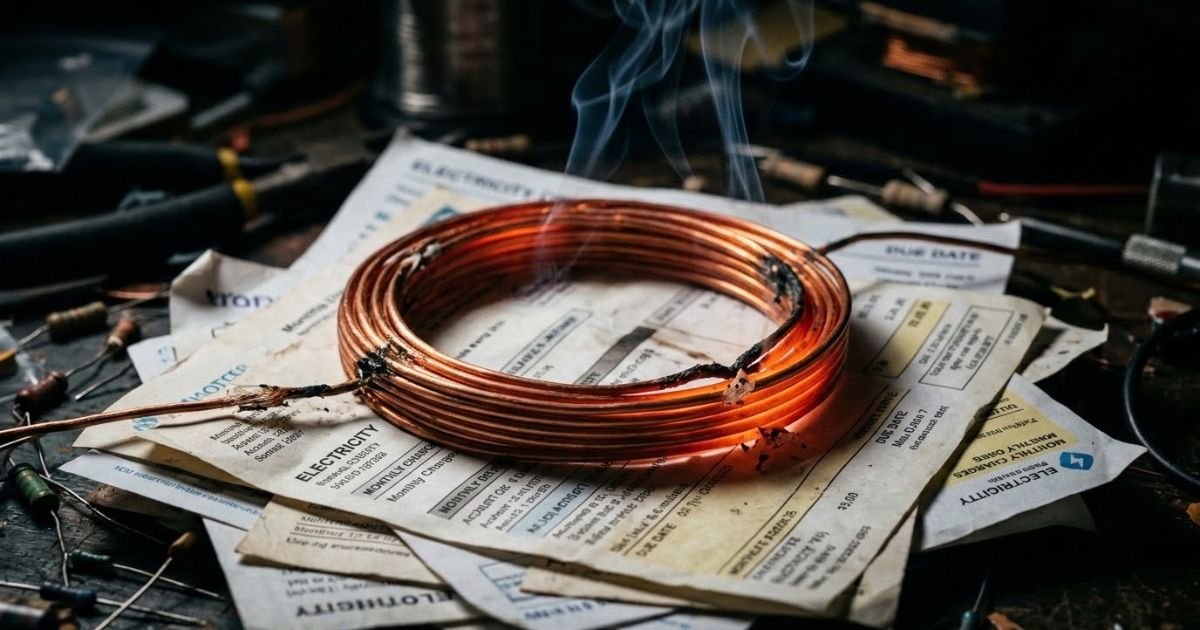
Let’s be honest: the idea of outsmarting the power company with a scrap bundle of copper wire is intoxicating. In a world where monthly utility bills feel like a slow, inescapable tax on existing, who wouldn’t want to believe that Nikola Tesla left behind a forgotten secret to break the grid?
Scroll through YouTube, TikTok, or dusty DIY forums, and you’ll find hundreds of slick demonstrations. A creator plugs a flat, spiral copper disk into a wall socket, hooks up a digital meter, and watches the current drop right in front of your eyes. It looks like magic. It looks like undeniable proof.
It isn’t. ✅ Check Official Availability & Discount Here:
Despite what viral clips and weekend “free energy” inventors claim, a Tesla pancake coil cannot lower your residential electric bill. While Tesla’s century-old bifilar design remains a brilliant stroke of electrical engineering, using it to cut your power costs is based on a fundamental misreading of basic physics—and a clever manipulation of how home electric meters actually track energy.
If you plug one of these coils into your wall, you won’t throw a wrench into the utility company’s profit margins. You’ll just waste electricity, heat up your living room, and potentially create a serious fire hazard. Here is what is actually happening inside that coil, why those viral video demos look so convincing, and what engineering solutions can actually drag your monthly bill down.
The Physics of Tesla’s Flat Bifilar Pancake Coil vs. Modern Grid Power
To see through the internet magic tricks, you have to travel back to 1894 and look at what Nikola Tesla was actually trying to build when he bent copper into a flat spiral.
What Is Nikola Tesla’s US Patent 512,340? (Inductance, Self-Capacitance, and Resonance Explained)
On January 9, 1894, Tesla was granted US Patent 512,340 for a “Coil for Electro-Magnets.” If you’ve ever opened an old radio or looked inside a traditional motor, you’re probably used to seeing cylindrical coils—wire wrapped around a central core like thread on a spool. Tesla did something entirely different: he wound two parallel conductors side-by-side in a single, flat, continuous plane.
Standard Cylindrical Coil:       Tesla Bifilar Pancake Coil:
[========]                       ( ( ( ( ( ( O ) ) ) ) ) )
(High Self-Induction)            (High Self-Capacitance)
Tesla didn’t build this “pancake” shape to alter his power bill. He was trying to solve a brutal headache in early high-frequency wireless research: self-induction.
In a standard wire coil, current creates a magnetic field that resists rapid changes in power flow. This produces a “back-EMF” (electromotive force) that chokes high-frequency signals. By winding two adjacent wires in parallel and connecting them in series, Tesla created a large voltage gap between adjacent turns of copper.
This mechanical trick vastly amplified the coil’s inherent self-capacitance ($C$), allowing the internal capacitance to counteract the inductive reactance ($L$) right inside the coil itself:
$$f_r = \frac{1}{2\pi \sqrt{L C}}$$
At a specific “resonant frequency” ($f_r$), the coil cancels out its own opposition to AC current, acting as a powerful energy storage device for high-frequency radio waves. Tesla engineered this geometry to build early wireless transmitters—not to lower the 60 Hz power usage in a modern family home.
Energy Harvesting vs. Energy Conservation: Why Pancake Coils Do Not Create “Free Energy”
Strip away the technical jargon, and every device connected to your breaker box has to answer to a strict master: The First Law of Thermodynamics. Energy cannot magically appear out of thin air; it can only change its skin.
$$\Delta U = Q – W$$
The internet myth promises that a flat pancake coil acts like a net, “harvesting” ambient electromagnetic fields (EMF) floating through your hallway walls and turning them into free, usable household power. But physics doesn’t work on wishful thinking:
- The ambient fields in your home are microscopic. The stray magnetic fields radiating off your living room walls are measured in tiny micro-volts.
- To harvest real power, you need extreme field strength. Generating enough ambient energy to illuminate a standard lightbulb would require an electromagnetic environment strong enough to cook human tissue.
- Mutual inductance isn’t free money. Any energy a coil picks up from nearby house wiring is simply stolen from that same wiring via magnetic coupling.
Trying to harvest household power with an external coil is like holding a miniature waterwheel under your bathroom faucet to power a water pump in the basement. You aren’t creating new water; you’re just adding friction, creating backpressure, and wasting energy.
Why Internet Scams Claim Tesla Coils Slash Electric Bills by 50%
If the physics strictly forbid it, why are thousands of people convinced these devices work? Because scam artists and misinformed tinkerers know how to exploit a gap in everyday knowledge using a cheap tool called a clamp meter.
| Electrical Metric | Unit of Measurement | Utility Billing Impact (Residential) | Role of Pancake Coil |
| Real Power ($P$) | Kilowatt-Hours ($kWh$) | 100% of your bill | Increases consumption via heat ($I^2R$) |
| Reactive Power ($Q$) | Volt-Amperes Reactive ($kVAR$) | 0% impact (Not billed to homes) | Alters local phase angle slightly |
| Apparent Power ($S$) | Volt-Amperes ($VA$) | 0% impact (Not billed to homes) | Vector sum ($S = \sqrt{P^2 + Q^2}$) |
The Power Factor Correction Myth: Reactive Power ($kVAR$) vs. Real Power ($kWh$) Billing
Here is how the classic video illusion works: A demonstrator clips a current meter around a wire connected to a heavy power tool. The meter reads 5 Amps. Then, they plug a Tesla pancake coil (or a grey plastic “energy saver” box bought off Amazon) into the same outlet. Suddenly, the meter display drops from 5 Amps to 3.5 Amps.
It looks like visual proof of a 30% power savings. But it’s an illusion created by ignoring the difference between Real Power and Reactive Power.
- Real Power ($P$), measured in Kilowatt-Hours ($kWh$): The actual, physical work turning your ceiling fan blades, glowing inside your toaster, or cooling your refrigerator.
- Reactive Power ($Q$), measured in $kVAR$: The magnetic energy that continuously sloshes back and forth between the grid and the electric motors inside your home appliances.
- Apparent Power ($S$), measured in Volt-Amperes ($VA$): The total combined current vector flowing through the wire.
The mathematical relationship between real work and total current flow is called the Power Factor ($PF$):
$$PF = \cos(\theta) = \frac{\text{Real Power } (P)}{\text{Apparent Power } (S)}$$
Motor-driven appliances push voltage and current out of sync. When you plug in a capacitive device—like a Tesla bifilar coil—it nudges the voltage and current back into alignment. This lowers the total current ($Amperes$) passing through that specific branch of wire.
Here’s the catch: Residential electric meters completely ignore reactive current. They are engineered to count Real Power ($kWh$) and nothing else.
While the video shows line current dropping on a hand-held meter, the actual speed of your home’s digital electric meter doesn’t change by a single fraction of a second. The coil changed the phase angle ($\theta$) of the sloshing energy, but it didn’t reduce the work being done—or the money leaving your bank account.
       Apparent Power (S) [VA]
            /|
           / |
          /  |  Reactive Power (Q) [kVAR]
         /   |  (Not billed by utility)
        /____|
    Real Power (P) [kW]
    (Billed by Utility)
EMF Harvesting & Induction Myths: Can a Flat Coil Capture “Radiant Energy” from Home Wiring?
Promoters love to wrap these devices in esoteric vocabulary, tossing around phrases like scalar fields, zero-point energy, or radiant energy harvesting. They tell you that a flat spiral coil can capture the “stray field energy” lost by your TV or refrigerator and pump it back into your system.
Faraday’s Law of Induction demolishes this idea with simple math:
$$\mathcal{E} = -\frac{d\Phi_B}{dt}$$
To induce meaningful voltage ($\mathcal{E}$) in a loop of wire, you need a rapidly changing magnetic flux ($\Phi_B$).
Your home electrical system runs at a slow, plodding frequency of 60 Hertz (50 Hz in Europe), which has a physical wavelength roughly $5,000\text{ kilometers}$ long. A tiny copper coil sitting on your workbench is miles too small to tune into or capture significant energy from a 60 Hz wave. The minute fraction of micro-volts it manages to pick up dissipates into the surrounding air as invisible, useless warmth.
What Actually Happens When You Connect a Tesla Coil to a Home Circuit
If you decide to build one of these flat coils in your garage and plug it directly into your $120\text{V}$ wall outlet, three things happen instantly—and none of them are good news for your wallet.
Parasitic Losses, Heat Dissipation, and Fire Hazards
Copper wire is a great conductor, but it isn’t perfect. Every foot of copper has internal electrical resistance. When you force household current through a tightly packed coil of copper wire, you turn that coil into an electric heater via Joule’s First Law:
$$P_{\text{loss}} = I^2 R$$
Where $I$ is the current flowing through the wire and $R$ is its internal resistance.
Instead of shaving dollars off your monthly bill, the coil acts like a tiny, uninsulated space heater. It continuously siphons current out of the wall, converts it directly into waste heat ($P_{\text{loss}}$), and increases the $kWh$ consumption tracked by your smart meter.
Worse yet, home-made coils lack basic safety components. They don’t have thermal cutoffs, fused protection, or fire-rated insulation. Plugging an unrated copper spiral directly into a home circuit risks melting the enamel insulation, causing an electrical arc, tripping main breakers, or starting an in-wall structure fire.
Measuring the True Wattage Drop: Oscilloscope and Smart Meter Benchmarking
If you skip the hand-held clamp meter and test a pancake coil with laboratory tools, the myth falls apart completely:
[AC Power Source (120V/60Hz)] ---> [Inline Oscilloscope] ---> [Tesla Pancake Coil] ---> [Digital Smart Meter]
                                             |
                                  (Measures V-I Phase Shift)
- Oscilloscope Trace Analysis: Hooking a dual-channel oscilloscope across the circuit shows the exact relationship between voltage and current. Adding the coil shifts the current wave slightly to line up with voltage, but the total area under the power curve remains completely flat.
- Smart Meter Logging: Digital smart meters don’t get fooled by shifted phase angles. They sample line voltage and current thousands of times a second, multiplying them directly to calculate instantaneous real power:
$$P_{\text{active}} = \frac{1}{T} \int_{0}^{T} v(t) \cdot i(t) \, dt$$
Because the meter integrates $v(t)$ and $i(t)$ continuously, it bypasses the reactive phase shift completely. The digital display doesn’t slow down. In fact, it speeds up slightly to account for the extra wattage burned as heat in the coil’s copper wiring.
Verified Engineering Solutions That Lower Electric Bills (Instead of Coils)
If copper coils and plastic “energy saver” boxes are dead ends, how do you actually lower a stubborn power bill? You stop fighting imaginary magnetic fields and start fixing real-world thermal and mechanical inefficiency.
Residential Power Factor Correction for Heavy Inductive Loads (HVAC & Pumps)
While power companies don’t charge homeowners for bad power factor, massive inductive spikes from large equipment—like a 3-ton central air conditioning compressor or a deep well pump—do cause real damage. They create massive current spikes that heat up your home’s internal wiring and put heavy stress on your electrical panel.
Unoptimized AC Compressor:
[Grid] --------------------> [HVAC Motor] (High Heat Loss in Home Wires)

Optimized with Soft-Start / Power Factor Capacitor:
[Grid] ----> [Capacitor / Inverter] ----> [HVAC Motor] (Smooth Current, Low Wire Heat)
Instead of chaotic home-made coils, engineers use two time-tested systems to smooth out heavy electrical spikes:
- AC Soft Starters: A soft starter installs directly onto your central air unit to limit the massive “inrush current” when the cooling cycle kicks on. This eliminates the abrupt voltage drop that makes your kitchen lights flicker, reducing stress on the motor and extending its lifespan.
- Inverter-Driven Compressor Upgrades: Modern HVAC systems skip old-fashioned single-speed induction motors entirely. They use variable-frequency drives (VFDs) that convert AC to DC power, adjusting motor speed smoothly to match real-time cooling needs. This upgrades system efficiency by up to $40\%$.
Home Energy Audits: Eliminating Phantom Loads and Resistance Heating Waste
The most boring energy-saving methods are almost always the ones that yield the biggest financial returns. Real home efficiency comes down to managing heat transfer and phantom current draw:
+-----------------------------------------------------------------------+
|                       HOME ENERGY LOSS MAP                            |
|                                                                       |
|   [ Attic / Insulation ]  ---> Thermal Drift (30-40% HVAC Waste)     |
|   [ Standby Electronics ] ---> Phantom Loads (5-10% Base Bill Waste)  |
|   [ Resistive Heating ]   ---> Low COP Efficiency (1:1 Ratio Waste)   |
+-----------------------------------------------------------------------+
- Kill Phantom (Vampire) Draws: Modern televisions, soundbars, gaming consoles, and smart appliances draw power 24/7 just to listen for remote control signals. Plugging these clusters into Smart Power Strips—which automatically kill power to secondary outlets when the main device turns off—routinely saves $5\%\text{ to }10\%$ on baseline monthly power usage.
- Ditch Resistance Electric Heating: Baseboard electric heaters and standard electric hot water tanks operate at a 1:1 energy conversion ratio (1 unit of electricity = 1 unit of heat). Upgrading to an Air-Source Heat Pump or a Heat Pump Water Heater allows you to pull ambient heat out of the surrounding air, yielding a 3:1 or 4:1 conversion ratio that can cut heating costs by over $60\%$.
- Fix the Thermal Envelope: The single biggest drain on any residential power bill is heat crossing your walls and ceiling. Paying a professional for a blower-door air test and adding modern cellulose insulation ($R-38\text{ to }R-60$) to an under-insulated attic can drop your summer air conditioning costs by up to $30\%$ permanently.
What People Always Ask About Tesla Coils & Power Bills
Can a Tesla coil harvest usable energy right out of the air?
No. Atmospheric electromagnetic radiation is far too weak and spread out to be collected for household power. A custom coil exposed to ambient air might harvest a few micro-volts—barely enough to register on a delicate laboratory instrument, and nowhere near enough to power a single tiny LED light.
Why does my current meter drop when I plug in a capacitor or flat coil?
Hand-held clamp meters measure total current ($Amperes$), which includes both real active power and non-billed reactive power. Plugging in a capacitive device shifts the phase relationship between voltage and current, lowering the total apparent current. However, your utility meter only bills for real power ($kWh$), which remains completely unchanged.
What was Nikola Tesla actually trying to do with Patent 512,340?
Tesla created the bifilar pancake coil in 1894 to eliminate self-induction in high-frequency alternating current circuits. By placing turns with a high voltage gap right next to each other, the coil achieves high internal capacitance, allowing it to hit electrical resonance at high radio frequencies without needing external bulk capacitors.
Is it dangerous to plug a DIY pancake coil into my wall?
Yes, it is dangerous. Plugging an unrated copper coil into a standard wall socket acts like an uninsulated resistor or a direct short circuit. The wire can quickly overheat, melt its insulation, trip main breakers, or cause a catastrophic electrical fire inside your home.
What is the single fastest way to lower a high electric bill?
The fastest, proven way to drop your power bill is to target space heating and cooling. Adding attic insulation, sealing air leaks around doors and windows, and using a programmable smart thermostat will instantly yield real, measurable savings on your next electric bill.
-TRY Energy Revolution System on its official website:
Products / Tools / Resources
If you are looking to diagnose real energy waste in your home, measure actual wattage draw, or build a genuinely energy-efficient living space, these verified tools and resources are the gold standard:
- Sense Energy Monitor / Emporia Vue Smart Home Energy Monitor: Instantly clamp-installed inside your main breaker panel to track exact, real-time power consumption ($kWh$) for individual circuits and appliances directly on your smartphone.
- Kill A Watt EZ (P4460) Electricity Usage Monitor: A simple, reliable plug-in meter that measures the exact $kWh$, active watts, and true operating cost of individual plug-in devices like refrigerators, TVs, and window AC units.
- Micro-Air EasyStart AC Soft Starter: A professional-grade soft starter for home central air conditioners that reduces startup inrush current by up to 75%, protecting home wiring, easing generator load, and eliminating light flicker.
- FLIR ONE Edge Thermal Imaging Camera: An accessible thermal camera that attaches to your phone to instantly pinpoint air leaks, missing wall insulation, and overheating electrical components in real time.
- U.S. Department of Energy – Home Energy Audits Guide: The official federal resource for conducting DIY energy assessments or finding certified professional home energy auditors in your local utility region.